Pages

Thursday, September 16, 2021

Survival of the Shawangunks

“You are a survivor”

That’s what they say to you at the finish line of Survival of the Shawangunks, aka SOS, a triathlon that involves biking 30 miles and then alternatively running and swimming for a total of 18 and 2.5 miles, respectively. 

But I’m not sure I want that designation. I didn’t “survive” the race. 

Surviving would have been showing up so un(der)prepared that finishing was the accomplishment. And sure, anything can happen in a race (especially a race as crazy as this one), so there are reasons a fit, trained person might not finish. However, I felt confident going in that finishing was not going to be the challenge. The challenge was going to be getting the most out of myself and dealing with unexpected issues quickly and effectively. Because in a race with as many changeups as this one, with as many elements that I simply could not practice in training, there were bound to be at least a few issues. 

And there were.

Bike: 30 miles

Biking has been and perhaps will always be my weakest discipline. In fact, two months out from this race, I was concerned with whether I would be able to finish the 30 miles within the 2:15 cutoff time. The course starts out along flat cornfields and progresses into some rolling hills—right up until the last five miles, which are. All. Up. Hill. 

These hills were problematic for me on several levels. First, there’s the regular old speed issue: The slower you go, the worse you’ll place. And when it comes to triathlon, being slower on the bike is extra-disadvantageous because the longest leg of any triathlon is always the bike. Second, I’m not a great bike handler. In other words, when I’m climbing a hill, descending a hill, avoiding a pothole, turning, or doing virtually anything that requires attention or effort, I do not release my grip on the handlebars. And when my hands are thusly occupied, they can’t do things like rip open a packet of Gu or retrieve a water bottle—both of which would be essential to keep my internal reserves stocked up for the grueling running/swimming miles ahead.

The solution involved several gear-based adjustments devised by my friends/coaches/mentors J___ and N___.  They lent me J___’s much lighter (much more expensive) road bike, which had more gears available, which meant that I could keep my legs turning over on those climbs. They also lent me their hydration backpack so I could drink from the little dangling rubber “straw” that loops over your shoulder on my ascent rather than groping around for the water bottle cage that’s screwed in lower on the bike. It’s a good thing I had that backpack, too, because around mile 19 I accidentally dropped my regular water bottle as I was trying to get one last sip before the hills. (See? Terrible bike handler!)

Run One: 4.5 miles

The bike segment of this race concluded with dismounting and clopping across an asphalt parking lot to where we had to rack our bikes. (For anyone who has never worn bike cleats, imagine you are wearing one-inch heeled shoes, only the raised part is under your toes rather than your heel. That’s what it’s like trying to walk on flat ground in  bike cleats.) At the bike rack, a plastic bag containing my swim/run gear awaited. I don’t like to make lots of mid-race choices if I can help it, so my gear was minimal: sneakers, swim cap, and goggles. I stuffed my bike cleats, helmet, and gloves into the bag, donned my running shoes, and set off with cap and goggles in hand. (I eventually stuffed them between the strap of my sports bra and my shoulder, which is where I stowed them on every run thereafter.)

I’d practiced very few bike-run transitions (otherwise known as “bricks”) in training, so I wasn’t sure quite how I’d feel at this stage of the race. I knew the course started uphill, so even if I felt “good” I knew I wouldn’t be running fast. To my surprise, I ran the first few miles at a mid/low 7 min/mile pace, and I felt fairly in control. Of course, then the hills kicked. The iconic “Cardiac Hill” occurs in that first run, so my pace slowed, but I’d been expecting it, and all in all I didn’t feel terrible—which made me optimistic for the remaining several hours of racing.

Swim One: 1.1 miles

One of the things that makes this race unusual is the fact that you have to bring your shoes with you into the water. No other triathlons require this, because the swim is always first; you go in shoeless, come out shoeless, and then put shoes on for the biking and running segments. In SOS, you run to a lake, swim across that lake, and then get out and run again . . . to another lake. You do this three times. Therefore, if you plan to run wearing shoes, you need to bring them with you across those lakes.

How you do this is entirely up to you. Some people carry dry bags, others stuff their shoes into the zip-up section of their tri suit. My plan (courtesy of race veteran “Dr. Mike”) was to stuff the shoes up the back of the legs of my tri suit. If you want to try this at home, take a sneaker and hold it against the back of your thigh, toes pointed toward your butt, sole out. Now imagine you’re wearing spandex shorts, and jam the shoe in between the shorts and your upper thigh so they’re nice and snug and ready for a swim. That was the strategy, and it worked! The most difficult part was getting the shoes on and off my feet. In this first swim, it wasn’t so bad, because I was still wearing socks, which I had worn on the bike. (Pro tip: Don’t try to swim in socks. I gave it a shot, but after a few hundred meters I had to shed them. They somehow really impair your kick!)

This first swim was the longest and in the coldest lake. It was made even more challenging by two additional factors: First, the water was choppy. Like, really choppy. Ocean-swim choppy. The waves made breathing difficult, but it made sighting (the process of lifting your head to see where you’re going) almost impossible. And second, sighting was already difficult because there were no buoys. Usually in open water swims, there are bright orange, red, or yellow buoys floating in the water that you use in order to ensure you’re swimming in the right direction. However, in this lake there were only two buoys: one where you enter the lake, and where you exit a mile away. Suffice to say, I did a fair amount of breast stroking to get my head high enough to find other swimmers I could swim toward. Being half a mile from shore and unable to see what direction to swim is not great, especially in the middle of a race!

Run Two: 5.5 miles


The second run was probably the most enjoyable due to what wasn’t happening yet: I wasn’t feeling tired, and I wasn’t developing blisters. Also the terrain of this run was generally gentler, the path smoother, and the inclines and declines less steep. (Although again, I wasn’t as tired yet, so don’t quote me!) 

It’s on this run that I caught up with people from the SOS “camp” I had done a month prior, all of whom I’d judged to be formidable athletes. It felt good to breeze past them while feeling in control. The third run is going to be the tough one, I reminded myself as I pranced downhill. That’s where the real race starts.

Swim Two: 0.5 miles

Before I could get to that “tough run” though, I first had to get through the second lake swim. This one was much easier than the first, by virtue of the fact that the water was warmer and there was a yellow rope strung straight across the lake, from the entry point to the exit point. What I should have done was keep my head down and breath to my right for the whole swim so I could navigate using that yellow rope, but I was too stuck in “open water swimming” mode and kept lifting my head to look in front of me, even though there was no need. Definitely something I’d do differently next time

I passed one swimmer about halfway across, and I was three quarters of the way when a man blew by me. By the time I thought “maybe I can draft off of him” he was a whole body length in front of me—too far to catch any useful draft. I knew who it was: A___, who had been part of the camp, who had shared all of his tips and tricks, and who had said in no uncertain terms that swimming was his best discipline. I was impressed, because it’s not like I’m a particularly slow swimmer, and the guy is at least in his 60s.  But I knew I’d catch him on the run. And I did.

Run Three: 8 miles

The third run was THE run, in my mind. This was the leg of the race I really wanted to nail. It was far enough into the race that I could be sure everyone would feel miserable, and yet it was flat enough that I knew I could run it well if I did things right.

As it turns out, most of the eight miles was not just flat, but downhill. In fact, the very beginning of the route was steeply downhill, to the point of causing some serious quad damage as you try to keep from tumbling ass-over-teakettle. Thankfully that decline only lasted maybe half a mile before the pavement leveled out and transitioned back to groomed trail, and then I was off.

Now I was passing the real competitors. How did I know? Well some of them had their last names on the backs of their tri suits. That’s a sign someone’s at least taking triathlon seriously, right? Also they were all running; only one man I passed started walking, and when I saw him do it, I yelled at him to “please come along, I need company!” (He declined.) And finally, I was running fast—or at least faster than I’d expected. My plan was to run by feel, whatever a “marathon effort” should be. But thanks to the gently descending terrain, my watch told me I was cruising at a sub-7 min/mile pace. After four-plus hours of exercise, that wasn’t too bad!

About midway through this run, the trail wound past a popular climbing area. I darted around climbers who moved along the path in slow motion and cheered the way stoned Brooklynites might—with breathy, mid-octave voices that indicated they had no idea what was going on but that they were in good spirits and were happy to acknowledge my passing by. After leaving those khaki-clad groups behind, there were long stretches where I saw nothing but trees, rocks, and dirt . . . until eventually I glimpsed a woman with blond braids up ahead. Generally speaking, I’d passed a lot more men than women, so seeing her got me excited—another competitor! But soon the trail began ascending, and any ground I was gaining became moot; she vanished into the trees. I never glimpsed her again.

This ascent was the second named hill of the course, aptly called “Godzilla.” More than one person had told me they intended to walk it “so they wouldn’t cramp.” I was skeptical of the wisdom of this, so I asked a friend who had won the race a few years prior if he’d walked Godzilla. His response (after a multi-second pause to make sure I was serious) was, “Maybe I walked for a second to gather myself, catch my breath. But then I kept running.” 

All of this is to say, I hadn’t decided what I’d do on this hill before I set out, which left me straddling the two strategies: I would run (which on that gradient is more like a shuffle), then choose a tree or rock ahead, and give myself a walk break. A few steps into the “break” I’d get annoyed and choose another landmark which, when I reached it, would be when I had to start “running” again. I proceeded thusly up the never-ending hill, alternatively lambasting myself for losing sight of Blond Braids and telling myself that it didn’t matter because I wasn’t going to win this race anyway. (Plus what royally pissed me off was that I couldn’t even win this segment of the race. There is an award for “fastest third run,” but it’s an overall award, not gendered. And I might be a fast runner, but I’m not dude-fast.)

The other, progressively louder thread going through my head at this point was f*ck my feet hurt. My left foot had hurt from the start of the run, but I was now 100% confident that I’d developed blisters on the arches of both feet. I’d naively hoped that by doing a fair amount of my training runs sockless and putting waterproof Band-Aids on my heels, I might avoid damaging my feet. Alas, the best I could hope for was that at lake number three, the blisters wouldn’t burst while I wrenched my shoes off or jammed them back on.

Swim Three: 0.5 miles

By the third swim, I was feeling a little delirious (this is five hours into the race, after all), and I was excited to get this last swim done. Entering the lake required sliding under a fence and down a dirt embankment, so by the time I hit the water, I still had my sneakers on. I had real trouble getting them off, which I first attributed to doing it in the water and then to my woozy state. Only after a good thirty seconds of failure did I realize that I’d forgotten to loosen the laces.

With that problem solved, I stuffed the shoes into the legs of my tri suit and dolphin-dove in . . . only to feel sudden stabbing pain as both of my calf muscles seized up. Not now, I thought as I flexed my toes to ease the cramps. I’m so close to the end. Not now. The cramps would not let up. With every tiny flutter kick, my calves tightened from the back of my knees to my ankles, and so I did my best to move my legs as little as possible while dragging my body forward with shoulders made of lead. (No one warns you how tired running can make your arms and shoulders!) The farther I swam, the louder the voice in my head shouted, What are you going to do? How are you going to get up that last hill?

Run Four: 0.7 miles 

The last run may have loomed large in my mind, but before I could attempt that, I had to get out of the water. It was no small feat. Balancing on sore calves atop yet another rock submerged in lake water, I did my best to shove my wounded feet into sopping shoes before scrambling up a rocky wall. (That’s right, there’s veritable rock climbing in this race!) At the top I stared around in a frantic daze until a volunteer finally pointed the way forward, and onward I went, alternatively shuffling and walking, panting all the while. Blond Braids was gone, and I knew the pros had finished eons ago, and there was no one behind me, so I made an effort, but I know myself, and it wasn’t all-out.

Thanks K___ for convincing me to do this wacky race!
My feet hurt. The chafing inside my suit hurt. But I felt calm. I was almost done.

The Finish

When finally glimpsed the timer at the top of the peak, I thought there might be a mistake. I had told anyone who asked that I’d be satisfied with a sub-6-hour finish time. But the clock I was seeing read 5:20-something. My frazzled brain tried to reconcile these numbers, but the fact was that I’d actually started later than what that clock was calculating (my age group had started three minutes after the official start), meaning I’d gone even faster.

And then it was done. I crossed the finish line. Someone handed me a towel. Someone else handed me a medal. I waited for a feeling: of excitement, relief, pride, anything. I was among strangers on a mountaintop. I’d done a ton of work to get here, but that work was what had mattered; this was just the outcome.

I think what I was feeling was contentment.


TimePaceAG Place (F25-29)Gender Place (F)Overall Place
Bike1:58:2515.2 mph5 / 842 / 52130 / 145
Run135:077:48 min/mi1 / 82 / 527 / 145
Swim1
30:401:35 min/100 yd3 / 812 / 5234 / 145
Run241:227:31 min/mi1 / 81 / 523 / 145
Swim2
16:391:53 min/100 yd2 / 89 / 5223 / 145
Run355:466:58 min/mi1 / 81 / 522 / 145
Swim3
14:081:45 min/100 yd2 / 811 / 5245 / 145
Run46:199:01 min/mi2 / 89 / 5225 / 145
Overall5:18:34N/A2 / 86 / 5222 / 145

Saturday, September 11, 2021

SOS Pre-Race: Switching Things Up

I’m racing a triathlon tomorrow. Surprise!

Truly, it’s been a season of surprises. 

"Tri Camp" (aka course preview)
For the first time ever, or at least in a very very long time, I enjoyed the act of training more than the prospect of the race. Now don’t get me wrong—if the race were cancelled (god forbid), I’d be pretty displeased; it’s what has kept me focused on and committed to training all this time. (I do not know how people push themselves without this sort of goal. Kudos to those who can!) Yet as the months ticked by, I realized that more than performing well on race day, I was generally looking forward to fitting this training into my life. It’s a jigsaw puzzle, but I was just generally excited to see how my body would respond to this new endeavor. Would swimming exhaust me so that my run immediately afterward was a slog? (Yes, initially, but as I got fitter the swim actually helped get me loose for the run!) Would biking ever get any easier? (Yes and no: I hate it less, fear it about the same, and am marginally better than when I started, but no one would ever mistake me for a “cyclist” or probably even “triathlete.”) Would running less mileage mean losing running fitness altogether? (No. Although how this translates to an actual running race remains TBD.)

A lot of this was surprising to me—I really tried to go into the experience with a mindset of “if I wind up feeling unfit or generally weird or lonely, it’s okay,” but I’ll admit it: I was nervous. Instead I got more (mostly) welcome surprises. A few worth mentioning:
  • Despite putting in at least as many overall training hours as when I’m marathon training, I felt about a third as “beaten down” throughout the four-month training cycle. I know everyone talks about what a “toll” running takes on your body, but I’ve always thought that immensely exhausted, can’t-lift-my-feet feeling was the price of fitness. (After all, back in college when I was swimming doubles and lifting two to three times a week, I could barely drag myself up and down stairs, and I fell asleep in nearly every dark, auditorium-style class.) My “undercarriage” is less pleased with me, and I’ve chafed and blistered in brand new places, but I’d be lying if I said I missed that feeling of utter eyelid-slamming exhaustion around 2pm every day.
  • Training alone is not as miserable as I expected. In the past, whenever I’ve had to do hard running workouts alone, I’ve struggled. Not all the time, not to the same degree every time, but more often than not, I failed to hit the prescribed workout 100%. This has trained me to avoid working out alone if at all possible. Yet if you think trying to find a running partner who can run your pace and is willing to run your workout at your (or their) preferred time is hard, try finding someone who is your swimming pace, interested in doing your swimming workout, and can arrive at the same (probably inconveniently located for one of you) pool at the same (very narrow window of) time. Seriously, I dare you. Try it, and then report back. Needless to say, I did every single swim set—and about 90% of my biking and running workouts—alone. And it actually wasn’t that bad.
  • So grateful for the guidance and generosity of friends.
    One reason it wasn’t that bad is because most of these workouts were effort-based. “Run 15 minutes at 85%” is not something I’ve done much of, nor is “swim 5x75 hard with 30s rest between each.” I’m used to knowing what pace I’m targeting and trying my darndest to hit it. Those paces, of course, are all numbers, which means you either nail them or you don’t. It’s pretty black-and-white: If you don’t, you failed. But when there are no numbers to hit, you can’t really fail. So this was, if nothing else, a nice vacation away from that little gremlin at the base of my brain who likes to pipe up right when I’m really hurting and declare, “You suck. You will never be able to do this. Every success you’ve ever had was a fluke. This is the real you, and the real you can’t do shit.”
  • Another reason working out alone wasn’t so bad is because in two of the three sports (i.e., biking and swimming), I essentially was starting over from zero. A year of COVID meant a year of no swimming, and anyone who knows me knows that I don’t ride bicycles if there is any viable alternative. This means that even in the case where I do have a past self to compare to (I swam collegiately . . . it’s a long story), I know the amount of work that past performance required, and I know that I’ve barely done a fraction of that work. Therefore, I cannot compare to that swimmer. And while I’ve done triathlon before, I’ve never put in any real bike training effort. Therefore it was like being new in these sports, and everyone knows that being new in a sport is the best because improvements are visible in short order, and seeing progress is motivating.
  • The last surprise was how flexible I learned to be. Sometimes pools simply were not available when I wanted or expected. (I showed up at a pool more than once only to have the gates locked, no humans in sight.) Bad weather also played a bigger role, as it’s inadvisable to bike or swim outside during, say, a thunderstorm. In these situations, I did my best to be resourceful, but sometimes you just cannot do what you planned. So call it maturity (the gremlin would call it laziness), but for whatever reason, I increasingly found myself being okay with these changes of plans. I hope I can maintain this outlook, because it’s so, so liberating.

Of course, there was one final surprise that was not so great. The fact of the matter is that I cannot seem to make it to the start line of a big race without some sort of crisis happening. This time it wasn’t my mother, father, or sister, it was my cat.

I think we'll keep her.
For those of you who have never owned a pet, you’re probably rolling your eyes. I get it! I didn’t birth this creature; it doesn't share my DNA. For those of you who are pet owners, however, I think you’ll understand that when I say my cat started throwing up last weekend and then did not eat or drink for an entire week, when she curled up in corners on soft surfaces and barely moved day or night, it was a crisis. Tabouli is four years old. She can’t tell us what is wrong, can’t point to where it hurts. And, as I learned on one trip to the vet (there were two in a matter of three days), cats are really, really good at disguising pain. (It’s apparently some sort of survival mechanism?) Thirteen hundred dollars, four stressful Uber rides, three “shot in the dark” medications, two teary breakdowns, and a whole lot of useless googling later, she magically started eating. The day before I left for this race, she went over the wet food bowl, which we kept refreshing, and took a bite. And another bite. And eventually that little spoonful of wet food was gone.

Relief is not something that is added to a person, it’s a release—like a balloon letting out helium, or whatever bad breath huffed into it. So I had about twelve hours to be a saggy, deflated balloon, and now I’m filling back up with nervous excitement. I don’t think I’ll be as full as I might have been, but I can feel the lift. That’s why we do these races: for the flutters of anticipation, and the battle on the course, the triumph at the end. I’m aiming for the finish line of the SOS Triathlon (and if you don’t know what it is, it’s worth a quick read). There’s no guarantee I’ll make it to the end, and certainly no guarantee of how I’ll place. But that’s why we race.

Sunday, May 17, 2020

The Olympic Trials Marathon

She might never know it, but Ali Feller gave me the permission I needed to finally write this recap.

Photo credit: Johnny Zhang
Ali is the host of the immensely successful podcast Ali on the Run, and in a recent episode, she interviewed Jay Holder, Director of Marketing & Communications at the Atlanta Track Club (ATC). Without shame–and perhaps, more importantly, without COVID apologies of any sort–she and Jay went straight back to that last weekend in February, when the Olympic Trials marathon happened, and talked about it with abandon. I loved every second.

It's been two months now since the trials, and I've wanted to write about the event. But I haven't. First I needed a week to settle down. Then I needed a week to process. And then . . . a worldwide pandemic happened. Ever since, I've been paralyzed by the fear that it's too self-centered, or tone deaf, or downright irrelevant to write about a happy, once-in-a-lifetime occasion like the Olympic Marathon trials.

But then I heard Ali's podcast, and her enthusiasm for the event took me straight back to that weekend. So I figure if she didn't even run the race and is still that excited to talk about it, and if I enjoyed listening, maybe this blog post will offer a reprieve from the "will we survive?" mentality of the media we're consuming every single day.

If I'm going to recount the experience of running the Olympic Marathon Trials, I want to begin with the weeks leading up to the whole event. Obviously I was training, but unlike many of my competitors, my goal was not to build fitness. Qualifying in Philly had taken everything out of me, and as stoked as I was about the upcoming weekend's experience, I was not excited to actually run a marathon. So leading up, I just needed to stay fit enough to compete without breaking down.

Yet while the training may not have been exciting me, the ever-mounting hype was simply unavoidable. And it was infectious. For the first time in my life, I was being sought out for my opinions, my words, my likeness based on something I'd achieved. Usually I'm the one on the question-asking end of the conversation, but now people wanted to interview me for articles. They filmed me for a television segment. Put me on their Instagram feed. Included me in their podcast. (Okay, full disclosure, I was on the podcast earlier, but that's because the host is my friend, and he needed someone to help him practice.) I have never, ever felt this much like a celebrity. And, knowing that I will almost certainly never experience this again, I said yes. Yes, take my photo. Yes, ask my opinion. Yes yes yes!

Photo credit: Ben Ko
Fast-forward to the weekend of the event. The best way I can describe the experience is that it felt like stepping onto one of those moving walkways and never getting off. From the moment we set foot in the Omni hotel, the energy was thick, palpable, high-octane, and unrelenting. I couldn't leave my room without tripping over someone I knew, or had heard of, or wanted to meet. Every hallway was loud, and everyone was always in motion, going somewhere.

Initially I'd thought that I'd have a decent amount of downtime. However, there was just so much to do! Between eating meals and attending events the ATC was putting on for us athletes, I had to sort out what, exactly, I was going to wear for the race; go and get it approved by a race official (including my shoes, which were measured using what looked like some sort of laser); decorate and drop off my water bottles (where I ran into none other than professional runners Steph Bruce and Allie Kieffer, decorating their water bottles); and attend mandatory athlete briefings. Oh, and I'd also planned to meet up with a few friendly and professional contacts, see my teammates, and eat dinner with my parents. So yeah. There wasn't time for much else.*

As with everything else that weekend, the race was nothing like any other race I've ever run. Part of it was me.** At most marathons, I am dialed in. While I'm running, I see little and hear even less. At this race, I saw everything and heard everyone. The crowds were insane. They were louder than I've ever heard . . . and I've run the Chicago, Boston, and New York marathons. Plus, these crowds were so much closer. The out-and-back course meant that fans could line both sides of the street, and the onslaught began immediately at the start line and extended for two straight miles, maybe more. In that pack were family and friends. And sure, many of them were there to see the race, the spectacle, but they were also there to see me. I can't quite explain what that feels like. I guess it feels like love.

Photo credit: Kelly Kilgour
I saw my ex-teammates first, screaming their heads off, phones out, signs up. These are women who were some of my first New York running friends. They bought plane tickets practically the day I qualified. "Wouldn't miss it," they told me. "We're so proud of you."

Then I saw current teammates–women who had poured their hearts out to hit the trials standard just a few months ago and come up short. These women weren't slower than me. On any given day, they'd be the ones running this race, and I'd be the one on the sidelines. These women (and their partners) had flown to Atlanta late the night before; they were going to cheer themselves hoarse at this marathon; and then they were going to get back on a plane, all so they could run a 5k the next day back in New York. Those are the kind of teammates I have. They're the kind of teammate I aspire to be.

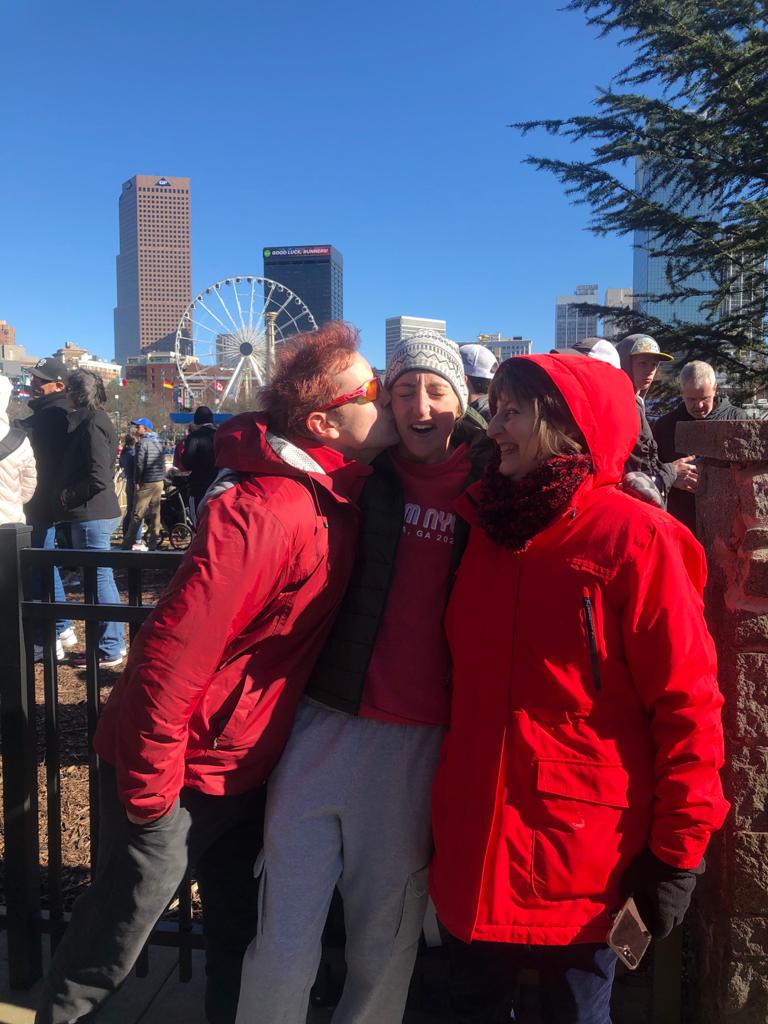
Next up was my family. It's important to note that my parents haven't seen me run a marathon since my very first race back in 2009. I genuinely wasn't sure, if I qualified for this trials, whether they'd attend. But there they were: my dad with his goofy homemade sign, my mom bundled in her puffy bright red coat, hollering and smiling and just looking so happy. And right there next to them was the single-most steadfast guy who has been with me through my good races and my bad, who has cheered for me in the heat and the rain, who really truly has helped me get here, whether he acknowledges it or not.

I saw my neighbors–runners in their own right, and who have been amazingly supportive–cheering like crazy and snapping photos left and right. ("You're doing it!" one of them screamed when I passed them around mile 20-something, almost certainly looking like death. Has a truer cheer ever been cheered? It was exactly the right thing to say.)

There were my two high school friends, neither of whom has a particularly strong interest in running, but who came anyway, for no other reason other than to make signs and stand outside for a bunch of hours to show me they love me.

There was my coach, who was probably the happiest I've ever seen him, smiling and waving and cheering me on.

And then there was one last teammate. This is a woman I haven't known for very long, but who I will never forget. She had qualified for the trials at the New York City marathon, more than a year in advance, but right before the trials, she suffered a knee injury that required surgery. While at first she was hopeful that she'd still be able to race (and cross-trained accordingly–that is, more than any sane human would), as the day drew near, her hope was stripped away bit by bit. At first, her goal was just to finish the race, then just to make it halfway, then a mile. Finally, she settled for the start line, making it 2 minutes and 40 seconds into the race before bowing out. Maintaining hope and optimism throughout that ordeal is impressive enough, but it's what she did after that 2 minutes and 40 seconds that really shows you who M___ is and why I admire her so much: She took her disappointment and her swollen knee back out onto the course and cheered on her teammates for the rest of the race. I genuinely couldn't believe it on that final lap, when I was hurting so bad and in one of those "please just let me stop" phases, and I saw her standing in the road screaming her head off. Because I knew how she must feel–torn between devastating disappointment for herself and excitement and pride for the rest of us. Plus the exhaustion of standing and cheering for three-plus hours. Plus the pain of a swollen knee. And I was almost certainly pulling up the rear on her "cheer list" . . . yet there she was, cheering just as hard for me as for anyone who came before me. I can't quite express how much that meant to me.

I'll tell you what: I didn't stop running.
Photo credit: Andrew Dearling
* Honestly, it was all such a whirlwind that the best choice I made was, race morning, spending the final thirty minutes alone in my hotel room, earphones in, starfished across the king bed. (Song of choice? "Wait for It.")
** And part of it was the course and the conditions. 1,389 feet of elevation? 20mph gusts of wind? Nope, definitely never did that before.

Friday, February 28, 2020

This Is Not a Victory Lap

Me + Teammate at Finish Line PT
It's the eve of the Big Event. The one I trained and sacrificed and lost sleep to attend. The Olympic Trials Marathon. I did everything in my power to get here, and now the moment is at hand and I simply don't have the words. I don't know what to say.

I thought about writing about shoes. For those who don't know, there's this whole shoe controversy going on, where Nike has innovated a shoe that may give runners an advantage. It costs an arm and a leg. Here at the trials, they gave out their new alpha-shoe (aptly named) to every trials competitor for free, and suddenly runners are throwing the "nothing new on race day" rule out the window. The competitor in me also wants to wear them tomorrow because "everyone else might be wearing them and getting an advantage" but this time, unlike in Philly, the competitor isn't winning. The voice inside me that says, "You already have feet problems, you don't know what these will do to your feet. Live to fight another day" is winning. And also, I'm sick of the Great Shoe Debate.

Yep that's a jacked-up foot
So I thought about writing about what it was like to train amidst other qualifiers for this race. And here's the thing: when it comes to locals who qualified for the Trials, it's the top of the top in NYC running. Only the best get to go to this race, so those are the people training together, and suddenly, whether it's the short turnaround after Philly or lack of talent or whatever, I'm not keeping up. I literally cannot do the workouts these other women are doing, and it's frustrating. It's not that I feel competitive with them, it's more that I feel left out. Or like I should be able to join in, but for some reason can't hack it. It's kind of insane to feel this way, when I achieved my goal! I get to go to this amazing event that I qualified for! And yet. There's always "and yet."

More very professional-looking bottles
That's all a little depressing, however, when this really should be a celebration. So the thing I'm going to write about is the idea of a marathon being a celebration. For all of those who heard me talk about how I'm not in the best shape, and I'm not going to PR or even come close, I know you meant well when you said this but I have to make something very clear: The Olympic Trials Marathon Is Not a Victory Lap. A victory lap is a 400m jog with a flag draped over your shoulders, smiling and waving to fans. A marathon will never, ever be a victory lap. Even if I run the very slowest we're allowed, which for women is 3:14:59-pace at mile 16 (or else we get removed from the course), it's still not going to be a walk in the park. This course is hilly. And 26.2 miles long. I will try to smile and wave the best I can, but make no mistake: it's still a race. I'd still like to perform to the best of my current ability.

Someone really likes the new DPNYC gear!
Therefore, I ate my white carbs today, and paid attention to hydrating, and stayed off my feet, and took Zicam . . . and tomorrow I'm going to go out there and experience what it's like to run in the Olympic Trials. I'm going to stay present. I'm going to bring with me, in spirit, all of the people who I know tried so incredibly hard to do this tremendous thing, because they deserve to be here, too. I'm going to bring all of the luck-wishers and cheerleaders and supportive friends and family I have with me. And it's going to be painful and hard, and I'm going to get frustrated on the uphills, but I'll also be excited when I pass someone, and even more excited when I see people I know on the side of the course, yelling their heads off. Because this is the marathon.

Tuesday, December 3, 2019

Philly Marathon Race Recap: How to OTQ*

Step 1: Stay with a non-runner. In this case two of them, your cousin and his wife. Answer questions like "How many marathons have you run this year?" and "What pace are you going to run?" and "Are you going to win?" Also enjoy some really, really good home cooking.
Good-luck flowers!
Step 2: Receive surprise flowers (and totally mis-guess who they are from). Remember, for the first of many times this weekend, just how wonderful your friends are.
Step 3: Lose your race bib. There are many ways you can do this, but one surefire way is to put it in your training partner's identical backpack** after you take a photo together at the race expo. Make sure to tear your whole room apart in a panic before thinking to call her and having your fears eased.
Step 4: Watch The Lion King. Followed by an Iliza Shlesinger Netflix comedy special. All while eating white bread and Trader Joe's Scandinavian Swimmers. (After being fed a personal dinner of spaghetti with marinara while everyone else ate steak and brussels sprouts.)
Step 5: Wake up at your usual "workout wakeup" time. Eat a banana and dry Honey Bunches of Oats, just like you always do. Pack a Picky Bar for later.
Step 6: Squeeze into an over-crowded, muddy "elite" tent, along with all of the pacers for the race, and also Meb Keflezighi and Des Linden, who you will not get a photograph with, because there are only ten minutes left and you need to get to the start line.
Step 7: On the start line, look into the faces of women you know, three of whom were your training partners for the past six months. Let yourself feel excited--this adventure is about to begin.
Step 8: Smile at the rain gods, because they are smiling at you. The rain has stopped. The race gun goes off. It's time to get down to business.
These look "elite" right?
Step 9: Grab your very first "elite" water bottle ever. Try not to fall over the other eight women going for their bottles at the exact same time on the exact same table. Make sure you snag that yellow pipe cleaner "handle" you duct-taped on for its snagability. Try to get back to your pace group in one piece. Discover that you have chosen a very stiff bottle, which was a mistake; now you must attempt to suck the liquid out while still breathing oxygen and maintaining pace. Eventually pull off the gu you taped to the bottle (with some really lovely pineapple-adorned duct tape) and pitch the bottle to the side of the street, where it proceeds to explode.
Step 10: Avoid the giant puddles. Or at least try, because anything could be down there. No need to twist an ankle this early.
Step 11: Get to the top of the One Big Hill In The Race without getting totally dropped. Catch back up to the pack. Let your breathing return to normal. Finish your gu.
Step 12: Notice that one of your teammates is gone. Maybe not gone, maybe just a few meters back. But this is not the time for feelings. You've just come past the halfway point. Refocus. Keep running.
Step 13: Almost trip your coach. Several times. Profusely apologize. Then almost get tripped by the girl running directly behind you several times. Must still be a tight pack.
Step 14: Greet your friend and teammate as she hops into the race. You might only get a word or two out, but that's okay--she knows how you feel, because she's already done this many, many times.
Step 15: Wonder if your attempts at "drafting" are working. It is very unclear whether, as the tallest woman in this group, running behind your friend and your coach--two extremely slender average-height runners--is helping at all. Figure that in this headwind, anything is better than nothing.
Step 16: Perform the running equivalent of elbowing a competitor out of the way to resume your place behind your coach. This is your pacer. If she wants to come along, she can run behind you.
Step 17: Arrive at the turnaround cone. Decide it's too slippery and you're too tired to make the turn. Stop running. Step around the cone. Then hurry to catch back up.
Step 18: Glimpse another training partner still headed "out" toward the cone. Try to guess how far back she is. Assume it can't be very far, but your mental faculties are starting to fail. Hope she is rallying for the final push.
The finish line is near. 
Step 19: Reach mile 21. Remind yourself, in a somewhat happy-yet-pain-filled fog, that this is the farthest you've ever run at this pace. Refocus on mile 22.
Step 20: Lose sight of your coach at the next water table. He had said he would grab water for your training partner. Is he coming back? Nope, because he shouts to go ahead. You're on your own from here on out.
Step 21: Arrive at Mile 23. Check your watch. Still on pace. You know, despite the dead-hurt feeling in your legs, that you can hold this for three more miles.
Step 22: Start feeling emotions swell at the base of your throat. Shut that shit down. There are still three miles left to run. Anything could happen.
Step 23: Arrive at Mile 24. See a familiar uniform up ahead. It's a woman you know. You haven't seen her all race, which means she went out hard. You have two miles. Keep going.
Step 24: Vaguely register Mile 25. It hurts so bad, but you are gaining ground. Now it's a race.
Step 25: Pass her on the final uphill. (An uphill!) Grunt what you hope sounds like encouragement, because this is a fellow New Yorker*** and you're both definitely going to make this 2:45 cutoff, so you might as well help each other get there. But you're also not slowing down.
Step 26: Cross the finish line.
Step 26.2: You did it. You are going to the Olympic Trials.

Amazing training squad & coach.
2019 Philadelphia Marathon Race Results

Race Length
Finishing Time
Average Pace
Overall Place
Gender Place
Age Group Place
(F30-34)
26.2 mi
2:44:11
6:15/mile
107 / 10,064
5 / 4,220
1 / 651

* OTQ = Olympic Trials Qualify. For women, this means running a marathon in two hours and forty-five minutes or less. For men, . . . I don't know (2:18 I think?), but it doesn't matter, because this procedure won't apply.
** Thanks again to Nike's Project Moonshot program. The backpack I received as part of the program is my new favorite (and I carry a lot of backpacks). However, it is others' favorite as well, which can be the source of such confusion.
*** Okay, okay, okay. She lives in New York. I am a Jersey Girl. But we both run in New York, so I'm standing by my "fellow New Yorker" terminology here.