Pages

Showing posts with label Adventures. Show all posts

Sunday, July 30, 2023

American Assholes in Mongolia

I didn’t go to Mongolia to be the American asshole.

I don’t think anyone goes abroad with the intention, right from the outset, to be a rude foreigner. However, if you’re like me, you are downright terrified of being perceived as such. You tiptoe around museums and slink into restaurants wondering how obvious it is that you don’t belong and whether you’re already doing something wrong. (Spoiler: If you’re white in Mongolia, it’s already clear you don’t belong.) You internally shudder every time you try to pronounce your tour guide’s name, imagining how many internal sighs she must be heaving. With your driver’s name, you don’t even make the attempt; you just smile, nod, and say thank-you, aka “bye-shla” (which you are 83% sure has a guttural, back-of-the-throat sound somewhere in there) a lot. You wonder if Mongolians assign bonus points for trying to pronounce their language, or if they’re more like the French and would prefer you to pry off their fingernails.

Needless to say, I spend a lot of my time abroad trying not to be the American asshole. Mongolia was no exception. And that’s why, when one of my merry band of friends started traipsing up the side of a very steep, grassy hill in Hustai National Park — on her way toward some very far-away wild horses that apparently had once been almost extinct — I had a few reservations. We’d arrived in a car, driven along one of the many, many dirt roads of the Mongolian countryside by the driver whose name I could not pronounce. We’d passed a few other cars and vans inside the park, but I’d seen none of their passengers go more than a few feet away from the vehicles. Clearly no one was here to police us; the entrance to the park was little more than a welcome banner and a very weathered-looking list of rules in spotty English. Still, was this something we were allowed to do?

So, I asked our tour guide — the Mongolian native whom we’d paid to tell us if we were about to do something stupid, dangerous, or just plain rude.

“No no, go ahead,” she said, waving at the hill. “It’s okay.”

With that reassurance, I high-tailed it up the hill after my friend. Soon all five of us tourists — four Americans and a Czech — were on the hill, closer but still craning our necks and squinting through camera lenses to see the horses, who, I will say, appeared entirely unbothered. One friend had brought a fancy camera with an even fancier telephoto lens, which he set up on a tripod and allowed us to look through. The only downside to this adventure (or so I thought at the time) took place when we traipsed back down the hill and I fell into a muddy creek. But that’s not the point of this story.

Our driver was the one who had spotted the horses, so it was no surprise that the next time he stopped our car, he had spotted more wildlife, this time animals called red deer. Like before, we all got out of the car and started up the hill (a new one) to get close enough to see the deer through our friend’s fancy camera lens. The deer were harder to spot than the horses, so after a few sub-par sightings, I decided to turn and head back to the cars. The others stayed a little longer, so I was ahead of them when I reached the bottom of the hill. There, I found another van parked behind our car and several older white people standing in front of it, staring up the hill. As I got closer, I heard a very distinct “assholes” enunciated, albeit with a European accent, from one of the men. Suddenly I was sure they were looking at me.

No sooner had I reached our car, when one of the women from their party stepped in front of me.

“Excuse me,” she said, frowning. “I must say something.”

They had been talking about us. My heart dropped.

“I come here every year, and I am just appalled. You all walk up there, bother the animals. It ruins things for everyone. Now the animals will not come closer. We will not see them maybe next year. It is ruined for everyone because you do what you like. This is very rude. It makes me very angry.”

She was glaring at me. Her voice was raised. Oh my god, she was mad at me. Me, the American. I was furthering the stereotype. She thought we were all assholes! I wanted to crawl under the car. But I didn’t.

“It makes me so angry. You all have made me angry,” the woman repeated, louder this time. 

“Understood.” That was the best I could do, as far as responses go. I felt ashamed, and also mad about feeling ashamed, and I thought I might start crying. Thankfully, with one last glare, she turned back to her comrades, who all had expressions on their face that were a cross between sneers, frowns, and suppressed laughter. They’d be talking about this the rest of the night, most likely. Those asshole Americans.

After taking a while to compose myself, I finally shared the encounter on our ride out of the park. The reactions were what I’d expected: indignation, exasperation, a little defensiveness. Everyone was sure we had been in the right and that those bossy Europeans were out of line. Upon reflection, that’s what I thought, too. But isn’t that what Americans, or perhaps even humans, always think? How would we know if we’d been in the wrong? We weren’t children trying to “get away with” something; we wouldn’t have done anything we thought was actively harmful. Getting yelled at by a stranger didn’t change our minds one bit.

This encounter clearly sticks with me. Maybe it’s because of the aforementioned terror of being perceived as the American asshole. Maybe it’s because I have an extremely thin skin and can’t handle getting yelled at by anyone, even a complete stranger. But maybe it’s because I am never quite sure how money shifts power dynamics. We were paying a lot to be there. Did our tour guide tell us what she thought we wanted to hear? Rationally, I doubt it; I think she’d have made us follow the rules if such rules existed. But emotionally? Emotionally I’m still afraid we did the wrong thing, simply because someone told me so in a loud, angry voice. I don’t know what that says about me, but it doesn’t seem great.

Thursday, September 16, 2021

Survival of the Shawangunks

“You are a survivor”

That’s what they say to you at the finish line of Survival of the Shawangunks, aka SOS, a triathlon that involves biking 30 miles and then alternatively running and swimming for a total of 18 and 2.5 miles, respectively. 

But I’m not sure I want that designation. I didn’t “survive” the race. 

Surviving would have been showing up so un(der)prepared that finishing was the accomplishment. And sure, anything can happen in a race (especially a race as crazy as this one), so there are reasons a fit, trained person might not finish. However, I felt confident going in that finishing was not going to be the challenge. The challenge was going to be getting the most out of myself and dealing with unexpected issues quickly and effectively. Because in a race with as many changeups as this one, with as many elements that I simply could not practice in training, there were bound to be at least a few issues. 

And there were.

Bike: 30 miles

Biking has been and perhaps will always be my weakest discipline. In fact, two months out from this race, I was concerned with whether I would be able to finish the 30 miles within the 2:15 cutoff time. The course starts out along flat cornfields and progresses into some rolling hills—right up until the last five miles, which are. All. Up. Hill. 

These hills were problematic for me on several levels. First, there’s the regular old speed issue: The slower you go, the worse you’ll place. And when it comes to triathlon, being slower on the bike is extra-disadvantageous because the longest leg of any triathlon is always the bike. Second, I’m not a great bike handler. In other words, when I’m climbing a hill, descending a hill, avoiding a pothole, turning, or doing virtually anything that requires attention or effort, I do not release my grip on the handlebars. And when my hands are thusly occupied, they can’t do things like rip open a packet of Gu or retrieve a water bottle—both of which would be essential to keep my internal reserves stocked up for the grueling running/swimming miles ahead.

The solution involved several gear-based adjustments devised by my friends/coaches/mentors J___ and N___.  They lent me J___’s much lighter (much more expensive) road bike, which had more gears available, which meant that I could keep my legs turning over on those climbs. They also lent me their hydration backpack so I could drink from the little dangling rubber “straw” that loops over your shoulder on my ascent rather than groping around for the water bottle cage that’s screwed in lower on the bike. It’s a good thing I had that backpack, too, because around mile 19 I accidentally dropped my regular water bottle as I was trying to get one last sip before the hills. (See? Terrible bike handler!)

Run One: 4.5 miles

The bike segment of this race concluded with dismounting and clopping across an asphalt parking lot to where we had to rack our bikes. (For anyone who has never worn bike cleats, imagine you are wearing one-inch heeled shoes, only the raised part is under your toes rather than your heel. That’s what it’s like trying to walk on flat ground in  bike cleats.) At the bike rack, a plastic bag containing my swim/run gear awaited. I don’t like to make lots of mid-race choices if I can help it, so my gear was minimal: sneakers, swim cap, and goggles. I stuffed my bike cleats, helmet, and gloves into the bag, donned my running shoes, and set off with cap and goggles in hand. (I eventually stuffed them between the strap of my sports bra and my shoulder, which is where I stowed them on every run thereafter.)

I’d practiced very few bike-run transitions (otherwise known as “bricks”) in training, so I wasn’t sure quite how I’d feel at this stage of the race. I knew the course started uphill, so even if I felt “good” I knew I wouldn’t be running fast. To my surprise, I ran the first few miles at a mid/low 7 min/mile pace, and I felt fairly in control. Of course, then the hills kicked. The iconic “Cardiac Hill” occurs in that first run, so my pace slowed, but I’d been expecting it, and all in all I didn’t feel terrible—which made me optimistic for the remaining several hours of racing.

Swim One: 1.1 miles

One of the things that makes this race unusual is the fact that you have to bring your shoes with you into the water. No other triathlons require this, because the swim is always first; you go in shoeless, come out shoeless, and then put shoes on for the biking and running segments. In SOS, you run to a lake, swim across that lake, and then get out and run again . . . to another lake. You do this three times. Therefore, if you plan to run wearing shoes, you need to bring them with you across those lakes.

How you do this is entirely up to you. Some people carry dry bags, others stuff their shoes into the zip-up section of their tri suit. My plan (courtesy of race veteran “Dr. Mike”) was to stuff the shoes up the back of the legs of my tri suit. If you want to try this at home, take a sneaker and hold it against the back of your thigh, toes pointed toward your butt, sole out. Now imagine you’re wearing spandex shorts, and jam the shoe in between the shorts and your upper thigh so they’re nice and snug and ready for a swim. That was the strategy, and it worked! The most difficult part was getting the shoes on and off my feet. In this first swim, it wasn’t so bad, because I was still wearing socks, which I had worn on the bike. (Pro tip: Don’t try to swim in socks. I gave it a shot, but after a few hundred meters I had to shed them. They somehow really impair your kick!)

This first swim was the longest and in the coldest lake. It was made even more challenging by two additional factors: First, the water was choppy. Like, really choppy. Ocean-swim choppy. The waves made breathing difficult, but it made sighting (the process of lifting your head to see where you’re going) almost impossible. And second, sighting was already difficult because there were no buoys. Usually in open water swims, there are bright orange, red, or yellow buoys floating in the water that you use in order to ensure you’re swimming in the right direction. However, in this lake there were only two buoys: one where you enter the lake, and where you exit a mile away. Suffice to say, I did a fair amount of breast stroking to get my head high enough to find other swimmers I could swim toward. Being half a mile from shore and unable to see what direction to swim is not great, especially in the middle of a race!

Run Two: 5.5 miles


The second run was probably the most enjoyable due to what wasn’t happening yet: I wasn’t feeling tired, and I wasn’t developing blisters. Also the terrain of this run was generally gentler, the path smoother, and the inclines and declines less steep. (Although again, I wasn’t as tired yet, so don’t quote me!) 

It’s on this run that I caught up with people from the SOS “camp” I had done a month prior, all of whom I’d judged to be formidable athletes. It felt good to breeze past them while feeling in control. The third run is going to be the tough one, I reminded myself as I pranced downhill. That’s where the real race starts.

Swim Two: 0.5 miles

Before I could get to that “tough run” though, I first had to get through the second lake swim. This one was much easier than the first, by virtue of the fact that the water was warmer and there was a yellow rope strung straight across the lake, from the entry point to the exit point. What I should have done was keep my head down and breath to my right for the whole swim so I could navigate using that yellow rope, but I was too stuck in “open water swimming” mode and kept lifting my head to look in front of me, even though there was no need. Definitely something I’d do differently next time

I passed one swimmer about halfway across, and I was three quarters of the way when a man blew by me. By the time I thought “maybe I can draft off of him” he was a whole body length in front of me—too far to catch any useful draft. I knew who it was: A___, who had been part of the camp, who had shared all of his tips and tricks, and who had said in no uncertain terms that swimming was his best discipline. I was impressed, because it’s not like I’m a particularly slow swimmer, and the guy is at least in his 60s.  But I knew I’d catch him on the run. And I did.

Run Three: 8 miles

The third run was THE run, in my mind. This was the leg of the race I really wanted to nail. It was far enough into the race that I could be sure everyone would feel miserable, and yet it was flat enough that I knew I could run it well if I did things right.

As it turns out, most of the eight miles was not just flat, but downhill. In fact, the very beginning of the route was steeply downhill, to the point of causing some serious quad damage as you try to keep from tumbling ass-over-teakettle. Thankfully that decline only lasted maybe half a mile before the pavement leveled out and transitioned back to groomed trail, and then I was off.

Now I was passing the real competitors. How did I know? Well some of them had their last names on the backs of their tri suits. That’s a sign someone’s at least taking triathlon seriously, right? Also they were all running; only one man I passed started walking, and when I saw him do it, I yelled at him to “please come along, I need company!” (He declined.) And finally, I was running fast—or at least faster than I’d expected. My plan was to run by feel, whatever a “marathon effort” should be. But thanks to the gently descending terrain, my watch told me I was cruising at a sub-7 min/mile pace. After four-plus hours of exercise, that wasn’t too bad!

About midway through this run, the trail wound past a popular climbing area. I darted around climbers who moved along the path in slow motion and cheered the way stoned Brooklynites might—with breathy, mid-octave voices that indicated they had no idea what was going on but that they were in good spirits and were happy to acknowledge my passing by. After leaving those khaki-clad groups behind, there were long stretches where I saw nothing but trees, rocks, and dirt . . . until eventually I glimpsed a woman with blond braids up ahead. Generally speaking, I’d passed a lot more men than women, so seeing her got me excited—another competitor! But soon the trail began ascending, and any ground I was gaining became moot; she vanished into the trees. I never glimpsed her again.

This ascent was the second named hill of the course, aptly called “Godzilla.” More than one person had told me they intended to walk it “so they wouldn’t cramp.” I was skeptical of the wisdom of this, so I asked a friend who had won the race a few years prior if he’d walked Godzilla. His response (after a multi-second pause to make sure I was serious) was, “Maybe I walked for a second to gather myself, catch my breath. But then I kept running.” 

All of this is to say, I hadn’t decided what I’d do on this hill before I set out, which left me straddling the two strategies: I would run (which on that gradient is more like a shuffle), then choose a tree or rock ahead, and give myself a walk break. A few steps into the “break” I’d get annoyed and choose another landmark which, when I reached it, would be when I had to start “running” again. I proceeded thusly up the never-ending hill, alternatively lambasting myself for losing sight of Blond Braids and telling myself that it didn’t matter because I wasn’t going to win this race anyway. (Plus what royally pissed me off was that I couldn’t even win this segment of the race. There is an award for “fastest third run,” but it’s an overall award, not gendered. And I might be a fast runner, but I’m not dude-fast.)

The other, progressively louder thread going through my head at this point was f*ck my feet hurt. My left foot had hurt from the start of the run, but I was now 100% confident that I’d developed blisters on the arches of both feet. I’d naively hoped that by doing a fair amount of my training runs sockless and putting waterproof Band-Aids on my heels, I might avoid damaging my feet. Alas, the best I could hope for was that at lake number three, the blisters wouldn’t burst while I wrenched my shoes off or jammed them back on.

Swim Three: 0.5 miles

By the third swim, I was feeling a little delirious (this is five hours into the race, after all), and I was excited to get this last swim done. Entering the lake required sliding under a fence and down a dirt embankment, so by the time I hit the water, I still had my sneakers on. I had real trouble getting them off, which I first attributed to doing it in the water and then to my woozy state. Only after a good thirty seconds of failure did I realize that I’d forgotten to loosen the laces.

With that problem solved, I stuffed the shoes into the legs of my tri suit and dolphin-dove in . . . only to feel sudden stabbing pain as both of my calf muscles seized up. Not now, I thought as I flexed my toes to ease the cramps. I’m so close to the end. Not now. The cramps would not let up. With every tiny flutter kick, my calves tightened from the back of my knees to my ankles, and so I did my best to move my legs as little as possible while dragging my body forward with shoulders made of lead. (No one warns you how tired running can make your arms and shoulders!) The farther I swam, the louder the voice in my head shouted, What are you going to do? How are you going to get up that last hill?

Run Four: 0.7 miles 

The last run may have loomed large in my mind, but before I could attempt that, I had to get out of the water. It was no small feat. Balancing on sore calves atop yet another rock submerged in lake water, I did my best to shove my wounded feet into sopping shoes before scrambling up a rocky wall. (That’s right, there’s veritable rock climbing in this race!) At the top I stared around in a frantic daze until a volunteer finally pointed the way forward, and onward I went, alternatively shuffling and walking, panting all the while. Blond Braids was gone, and I knew the pros had finished eons ago, and there was no one behind me, so I made an effort, but I know myself, and it wasn’t all-out.

Thanks K___ for convincing me to do this wacky race!
My feet hurt. The chafing inside my suit hurt. But I felt calm. I was almost done.

The Finish

When finally glimpsed the timer at the top of the peak, I thought there might be a mistake. I had told anyone who asked that I’d be satisfied with a sub-6-hour finish time. But the clock I was seeing read 5:20-something. My frazzled brain tried to reconcile these numbers, but the fact was that I’d actually started later than what that clock was calculating (my age group had started three minutes after the official start), meaning I’d gone even faster.

And then it was done. I crossed the finish line. Someone handed me a towel. Someone else handed me a medal. I waited for a feeling: of excitement, relief, pride, anything. I was among strangers on a mountaintop. I’d done a ton of work to get here, but that work was what had mattered; this was just the outcome.

I think what I was feeling was contentment.


TimePaceAG Place (F25-29)Gender Place (F)Overall Place
Bike1:58:2515.2 mph5 / 842 / 52130 / 145
Run135:077:48 min/mi1 / 82 / 527 / 145
Swim1
30:401:35 min/100 yd3 / 812 / 5234 / 145
Run241:227:31 min/mi1 / 81 / 523 / 145
Swim2
16:391:53 min/100 yd2 / 89 / 5223 / 145
Run355:466:58 min/mi1 / 81 / 522 / 145
Swim3
14:081:45 min/100 yd2 / 811 / 5245 / 145
Run46:199:01 min/mi2 / 89 / 5225 / 145
Overall5:18:34N/A2 / 86 / 5222 / 145

Saturday, September 11, 2021

SOS Pre-Race: Switching Things Up

I’m racing a triathlon tomorrow. Surprise!

Truly, it’s been a season of surprises. 

"Tri Camp" (aka course preview)
For the first time ever, or at least in a very very long time, I enjoyed the act of training more than the prospect of the race. Now don’t get me wrong—if the race were cancelled (god forbid), I’d be pretty displeased; it’s what has kept me focused on and committed to training all this time. (I do not know how people push themselves without this sort of goal. Kudos to those who can!) Yet as the months ticked by, I realized that more than performing well on race day, I was generally looking forward to fitting this training into my life. It’s a jigsaw puzzle, but I was just generally excited to see how my body would respond to this new endeavor. Would swimming exhaust me so that my run immediately afterward was a slog? (Yes, initially, but as I got fitter the swim actually helped get me loose for the run!) Would biking ever get any easier? (Yes and no: I hate it less, fear it about the same, and am marginally better than when I started, but no one would ever mistake me for a “cyclist” or probably even “triathlete.”) Would running less mileage mean losing running fitness altogether? (No. Although how this translates to an actual running race remains TBD.)

A lot of this was surprising to me—I really tried to go into the experience with a mindset of “if I wind up feeling unfit or generally weird or lonely, it’s okay,” but I’ll admit it: I was nervous. Instead I got more (mostly) welcome surprises. A few worth mentioning:
  • Despite putting in at least as many overall training hours as when I’m marathon training, I felt about a third as “beaten down” throughout the four-month training cycle. I know everyone talks about what a “toll” running takes on your body, but I’ve always thought that immensely exhausted, can’t-lift-my-feet feeling was the price of fitness. (After all, back in college when I was swimming doubles and lifting two to three times a week, I could barely drag myself up and down stairs, and I fell asleep in nearly every dark, auditorium-style class.) My “undercarriage” is less pleased with me, and I’ve chafed and blistered in brand new places, but I’d be lying if I said I missed that feeling of utter eyelid-slamming exhaustion around 2pm every day.
  • Training alone is not as miserable as I expected. In the past, whenever I’ve had to do hard running workouts alone, I’ve struggled. Not all the time, not to the same degree every time, but more often than not, I failed to hit the prescribed workout 100%. This has trained me to avoid working out alone if at all possible. Yet if you think trying to find a running partner who can run your pace and is willing to run your workout at your (or their) preferred time is hard, try finding someone who is your swimming pace, interested in doing your swimming workout, and can arrive at the same (probably inconveniently located for one of you) pool at the same (very narrow window of) time. Seriously, I dare you. Try it, and then report back. Needless to say, I did every single swim set—and about 90% of my biking and running workouts—alone. And it actually wasn’t that bad.
  • So grateful for the guidance and generosity of friends.
    One reason it wasn’t that bad is because most of these workouts were effort-based. “Run 15 minutes at 85%” is not something I’ve done much of, nor is “swim 5x75 hard with 30s rest between each.” I’m used to knowing what pace I’m targeting and trying my darndest to hit it. Those paces, of course, are all numbers, which means you either nail them or you don’t. It’s pretty black-and-white: If you don’t, you failed. But when there are no numbers to hit, you can’t really fail. So this was, if nothing else, a nice vacation away from that little gremlin at the base of my brain who likes to pipe up right when I’m really hurting and declare, “You suck. You will never be able to do this. Every success you’ve ever had was a fluke. This is the real you, and the real you can’t do shit.”
  • Another reason working out alone wasn’t so bad is because in two of the three sports (i.e., biking and swimming), I essentially was starting over from zero. A year of COVID meant a year of no swimming, and anyone who knows me knows that I don’t ride bicycles if there is any viable alternative. This means that even in the case where I do have a past self to compare to (I swam collegiately . . . it’s a long story), I know the amount of work that past performance required, and I know that I’ve barely done a fraction of that work. Therefore, I cannot compare to that swimmer. And while I’ve done triathlon before, I’ve never put in any real bike training effort. Therefore it was like being new in these sports, and everyone knows that being new in a sport is the best because improvements are visible in short order, and seeing progress is motivating.
  • The last surprise was how flexible I learned to be. Sometimes pools simply were not available when I wanted or expected. (I showed up at a pool more than once only to have the gates locked, no humans in sight.) Bad weather also played a bigger role, as it’s inadvisable to bike or swim outside during, say, a thunderstorm. In these situations, I did my best to be resourceful, but sometimes you just cannot do what you planned. So call it maturity (the gremlin would call it laziness), but for whatever reason, I increasingly found myself being okay with these changes of plans. I hope I can maintain this outlook, because it’s so, so liberating.

Of course, there was one final surprise that was not so great. The fact of the matter is that I cannot seem to make it to the start line of a big race without some sort of crisis happening. This time it wasn’t my mother, father, or sister, it was my cat.

I think we'll keep her.
For those of you who have never owned a pet, you’re probably rolling your eyes. I get it! I didn’t birth this creature; it doesn't share my DNA. For those of you who are pet owners, however, I think you’ll understand that when I say my cat started throwing up last weekend and then did not eat or drink for an entire week, when she curled up in corners on soft surfaces and barely moved day or night, it was a crisis. Tabouli is four years old. She can’t tell us what is wrong, can’t point to where it hurts. And, as I learned on one trip to the vet (there were two in a matter of three days), cats are really, really good at disguising pain. (It’s apparently some sort of survival mechanism?) Thirteen hundred dollars, four stressful Uber rides, three “shot in the dark” medications, two teary breakdowns, and a whole lot of useless googling later, she magically started eating. The day before I left for this race, she went over the wet food bowl, which we kept refreshing, and took a bite. And another bite. And eventually that little spoonful of wet food was gone.

Relief is not something that is added to a person, it’s a release—like a balloon letting out helium, or whatever bad breath huffed into it. So I had about twelve hours to be a saggy, deflated balloon, and now I’m filling back up with nervous excitement. I don’t think I’ll be as full as I might have been, but I can feel the lift. That’s why we do these races: for the flutters of anticipation, and the battle on the course, the triumph at the end. I’m aiming for the finish line of the SOS Triathlon (and if you don’t know what it is, it’s worth a quick read). There’s no guarantee I’ll make it to the end, and certainly no guarantee of how I’ll place. But that’s why we race.

Monday, September 24, 2018

Hood To Coast Recap: Teamwork and Traffic Jams

Almost exactly one month ago, I ran the Hood to Coast relay as the twelfth member of the North Queens Runners (NQR) team. Whenever I tell anyone about this, the number one question I get is, "Was it fun?"

Honestly, I'm not sure.

Carly & Garen, Leg 6
For those of you who don't know what Hood to Coast is, let me summarize: on the second-to-last weekend of August, 1,000 teams of 12 runners each (split into two vans of six) start at the top of Mount Hood in northern Oregon and run 199 miles across the state to Seaside, i.e., the Pacific coast of Oregon. Each of the twelve runners runs ~15-18 miles, split across three legs of the relay, which are run in rotation, equalling 36 legs in total. If your team is walking (or running very slowly), your first runner starts at the crack of dawn on Friday, with each subsequent sendoff containing progressively faster teams. If your team wins, you will finish in about 17 hours. If not, the cutoff time to complete the relay is 36 hours. There are very few rules: you can eat and drink whatever you want, drive (almost) whatever you want, and wear whatever you want (unless you are running at night, in which case you are required to wear an LED light vest and a headlamp).

Running a relay like this was an entirely new experience for me, and I think when we have new experiences, rare experiences, or experiences we've invested a lot of time and money into, we expect (and others expect us) to "have fun." No matter how we feel during the event itself, we tend to revise our story afterward in order to make it seem like it was a total blast. After all, our audience probably didn't have this experience, so the least we can do is give them the best highlights, right?

Well, this is going to be the best and worst highlights.

First I want to say that I am very glad to have had this experience. I really enjoy new challenges, and  I've certainly never run what amounted to approximately three 10k races in 24 hours, nor have I spent 24 hours with the same seven people in one van. I also love contributing to a team, and this team was especially great; everyone on NQR was enthusiastic and supportive, while also intent on giving their best effort toward our goal of winning the mixed division (i.e., teams with at least six women). Finally, I love competing, and I was surrounded by competitors, and we were working together toward a shared goal. That was really fun.

Literally stretching my legs
However, there were a lot of parts that were not so fun. There were things I expected to be unpleasant, like wearing perpetually sweaty, smelly clothes; eating room-temperature sandwiches that have been squashed into unrecognizable shapes; "sleeping" for a grand total of one hour in a cramped van seat; and squatting in not one, not two, but three different leafy roadside "bathrooms." But then there were other elements I did not expect. For instance, I discovered I really do not enjoy running in the dark. Where I live (right outside Manhattan), it's never truly dark; there are always so many street lights and car lights and lit-up storefront displays that visibility is never a problem. However, on the uneven, poorly lit sidewalks of suburban Portland, curbs drop off without warning and you never know when a tree root will emerge. And that was only my first leg; during my second (at about 3am), I spent five miles running through a pitch-black valley of fog. (Dinky headlamp + zero streetlights + fog = unabated terror of falling in an invisible potholes.) Fear is very stressful, and apparently when I'm running, I'm scared of the dark.

The other unexpectedly stressful element had nothing to do with running at all.

When I was initially envisioning this race, I pictured running through hill and over dale. I saw trees and grass and dirt and even a few inevitable highways. What I did not picture was how 1,000 teams--meaning 2,000 vans--would get from point A to point B (and then to point C, and then point D . . . ). As it turns out, while the athletes are running through the wilderness, their vans are winding through narrow, rickety back roads that were absolutely not designed to accommodate 2,000 vehicles at once.

Driving--or, rather sitting--in standstill traffic was unquestionably the most stressful part of the whole relay. Here we were, trying to test our physical limits, to see if we could prove ourselves to be faster and grittier than our competitors, and we being hamstrung by . . . what amounted to rush-hour traffic. We left one of our runners stranded at a checkpoint, out in the cold, for over twenty minutes. And on top of that, there was no cell service, so we had no way of telling our other van (i.e., our six other teammates) that we were way, way behind schedule.

Team NQR! Clearly a photogenic bunch.
The upshot is that we lost the mixed division title by one minute. That's five seconds per runner. Less than two seconds a leg. Yet, I felt robbed of what would otherwise have been disappointment, because it didn't feel like a real loss. There was no way to know if we actually ran slower than the team that beat us, because they left in the very last sendoff, fifteen minutes behind us. Maybe, as a result of their later departure, they had less traffic, and "drove" their way to victory. (Or, alternatively, maybe we would have lost by a wider margin if they'd been in our sendoff.) Without going "head to head" with them, there was no way of knowing if we could have closed that sixty-second gap. As a result, most of what I felt, upon reaching the beach, was fatigue, and most of what I remembered was glaring helplessly at endless red brake lights.

Of course, that's not the end of the story. At the awards ceremony, there was some insane drama involving the winning women's team, but we weren't there for it, because we had rented a beach house! For the rest of the weekend, the twelve of us sat in the hot tub, ate ridiculous quantities of food, drank equally ridiculous quantities of alcohol, and slept. A lot.

Now that was fun.

Sunday, May 15, 2016

Stuffed or Starving: A Conversation from the Split Personality of Every Freelancer


(Okay, maybe not every freelancer. Maybe just me.)

I’m a planner. I work best when I have a series of actions that I can execute one step at a time. In part, that’s why I like freelancing, and it’s also what I liked about school: every assignment can be broken down into actionable, time-stamped steps. Need to write a paper by the first of the month? No problem—just schedule research for this week, first draft next weekend, revisions the following week, and wah-la: a finished term paper! Plus, what’s even better about both school and freelancing assignments is that no one cares when, where, how, or even whether you perform any of those steps. They just care about two things: the deadline and the final product.

So scheduling and executing . . . not a problem. This means that, as work is rolling in—the “feast," as it were, because freelancing is nothing if not feast or famine—I am fairly successful at keeping the internal voice shouting Ohmygod you’ll never get this all done to a dull roar.

Because really, it all comes down to living by a saying my father loves: How do you eat an elephant?

One bite at a time.

And I can definitely do that.

Unfortunately, it’s when there are no bites left that I start to panic. Like, for instance, right now, when I’m sitting here blogging, trying not to think about the fact that I have gone thirteen days without working a single billable hour. Sure, I’ve written some emails about lining up potential work. I’ve had phone calls with a few prospective employers. I've even gone on job sites and applied directly for projects. But earned any cash money? No. Which leads to what I can only describe as an argument between the two sides of my Split Freelancer Personality. The exchange goes something like this:

All the work has dried up. No one will ever hire you again.

Untrue! We had tons of projects last month. Just wait it out.

Yeah, okay. Keep waiting. You know what they say about people who wait? They starve to death.

I don't think that's the saying. [pause] But yeah, I know, I should be doing more. Pitching more magazines. Researching more university writing departments. Looking for more freelance assignments. Networking. [shudder]

Orrrr you could just start looking for a fulltime job. Because that’s what you’re going to have to do, anyway, when this little endeavor of ours spectacularly fails.

Just because you’re scared doesn’t mean I have to give up already.

Scared? I’m realistic. Remember all those people who told you that writing is not a viable way to make a living?

Working 40+ hours a week at a job I hate isn’t making a living--it’s making a salary.

Let me know how those platitudes taste next month, when you're eating rice and water out on the curb.

Don’t be dramatic. I can pay the rent for several more months even if we don’t get any more work. And I will get work. I’m qualified. The work is out there. Other people are doing this.

Yeah, other people with advanced degrees and resumes that include NY Times bestselling authors.

Okay, fine, I might not have a MFA or a PhD in editing--do they even have those?--but I’m good at this damn it! Or at least I think I am. Some people have told me that I am.

Sure they have. If you sucked, would they have said anything?

Well. No. But I wouldn't have repeat clients if I sucked. And Professor X requests me personally!

One professor. Wow. Way to go.

Hey, we're just starting out. Be patient.

We've been at this for almost a year.

Ten months. And I like it! I like the work, I like the lifestyle. I feel way more fulfilled now than with anything I was doing before. And I don’t care if I never make six figures. That has to count for something, right?

Never making six figures and barely making five aren’t quiiiite the same thing.

Oh shut up. I’m going to go back to brainstorming articles to pitch.

Or you could take a nap. Because do you really want to spend all those hours researching and writing and revising, only to get paid $50 a pop? Plus, they might just reject you outright.

… or I could take a nap. Okay. You win. For today.

Wednesday, September 2, 2015

Survey Results

First off, a huge thank you to everyone who took the survey, responded on Facebook, emailed me, etc. Self-branding is quite the soul-searching process, I've discovered, so all of your input and suggestions have been extremely valuable.

THANK YOU!

Now, I've had several people ask me about the results, so I'm going to put them up here for you to peruse. However, I have to admit to one giant mistake I made when posting this survey: I did not explicitly indicate whether "1" meant best or whether it meant worst. Therefore, I am certain that at least a few people used "8" to mean best rather than "1" (which is what I had intended: for 1-8 to be ranked best-worst), which of course then skews the results.

That said, here's what I've got.

what's in a name...?
In spite of the ellipses, all of the original name options are shown in full on this graph
 except for the 3rd option from the top, which should be "Allison Editing Services."

People gave some really good reasons for choosing their favorite name, although some of the explanations were so good, I started feeling almost as lost as when I first posted the survey! Here are a few of my favorites:
Write, Edit, Allison -- It puts things in order of importance. I also like the one-syllable, 2-syl, 3 syl rhythm.

Allison, Wordsmith -- I think "editing" is too vague

Gold Edits -- I like how this one both combines your name, what service you're offering, and has a bit of flair/double meaning (Gold as in gold standard or first rate editing!). It's not as fun as some of the others but not totally sober either.

Allison L Goldstein -- It's you and at the end of the day people are hiring you. My guess is that you'll get more business by word of mouth than by someone picking up your card from a Starbucks (or name your favorite shop) counter. You're selling you and it's vague enough that should you ever evolve into author, screenwriter, director, or general contractor, the domain allows you to do so.

Ally Edits -- Ally: "to join (yourself) with another person, group, etc., in order to get or give support". It plays off your name while also sending a message that you are easy to work with and will form an alliance with the writer. You are part of their team.
I also got some fantastic--sometimes hilarious--suggestions for other business names. (Although unfortunately a number of the matching domain names were already snatched up.) In no particular order, here are some of the suggestions:
  • AG Editorial Services
  • Goldstone Content LLC
  • Editrix
  • Edit-chic
  • Halycon Editing
  • ReadingWritingAllison
  • Cleanedits
  • Goldstein Scribing
  • Word crisp
  • ED-IT
  • All Gold Media Services
  • Meditopolis
  • Word'em up
And now, for what you really want to know....

At the moment, I'm leaning toward using my full name, most likely with the "L," with a tagline of some sort below, kind of like this. (Anyone have any suggestions?) You could call this the lazy [wo]man's way out, because by going this route I can stay a sole proprietor and I don't need to register a fictitious "doing business as" name anywhere. However, my primary reason is that I agree with whoever made the comment about "people hiring me." I've spent many hours hunting down and exploring competitors' website, and I've found that those editors who market themselves under their own name strike me as somehow more trustworthy than those who offer services under a more anonymous business name. Ultimately, I always went to their "About Me" page anyway!

My main hesitation with this approach concerns my impending marriage: if I ultimately decide that I want to change my name, that will throw a huge wrench into things; I'll have spent all this time building my professional identity around my current name, and then what? But, as they say:

How do you eat an elephant?

One bite at a time.

slightly terrified elephant


Sunday, August 23, 2015

Help me choose a business name!

As many of you may or may not know, I am currently in the process of going into business for myself. I've been doing freelance editing, copywriting, and transcription work on the side for several years, and recently I decided to "up my game" and start soliciting editing work full-time.

As such, I need to do lots of fun professional things like building a website, buying a domain, and registering my business. (Oh and paying taxes. I've never felt so Republican in my life!) But first . . . I need a business name!

This is where you come in.

If you've ever bothered to read the acknowledgements pages at the back of a book, you'll notice that authors tend to thank editors by name (rather than thanking, say, Generic Editing Services, LLC, or even their publisher). Consequently, it's important to me to keep that person-to-person quality alive in whatever I decide to call my business. That being said, www.allisonlgoldstein.com doesn't say much about what sort of services I am offering, and if you saw Allison L Goldstein on a business card somewhere, would you pick it up? (I might . . . if there was a cool writing-related image on it. But I digress.)

All of that being said, if you have two minutes to spare, please take a look through the business names I've brainstormed so far and let me know which you like/hate. And, of course, if you have any other suggestions, definitely send them my way!

Create your own user feedback survey

Friday, August 21, 2015

Timberman 2015: Run to the Finish (Part III)

(Missed reading about the swim and bike legs? Never fear, you can read it all here: Part I Swim and Part II Bike.)

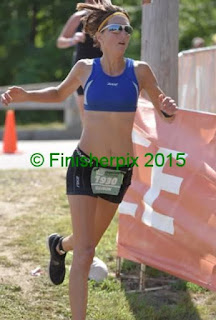
Helmet off. Bike shoes off. Sneakers on. Grab that race belt and your headband, skip the hat, it’s too hot. Grab your Gu. All three are there? Okay, go! Go! Go!—wait!

I turned around looked longingly back at the row where my bike was racked . . . with my running watch still attached to the handlebars.

Feeling good, giving smiles.
Just go.

No! You need it!

You don’t need it, you know how to run. You’re wasting time dilly-dallying around in here. Just go!

No but your splits! How will you know if you’re controlling your pace?

You can use the race clocks.

But what if there aren’t any on the course? Going back will only take a second.

And really, what was another thirty seconds in the scheme of things? I hurried back to my bike and retrieved the watch.

Now I was ready to go. I started running again . . . only to realize that I didn’t know where I was going. I had been heading toward the Bike Out area, but that was the same as the Bike In area, so surely they wouldn’t have runners and cyclists all trying to go in and out of the same spot. . . .

“Excuse me, do you know where the Run Out is?”

The girl racking her bike looked up and glared at me.

“Sorry.” I tried to smile. “But do you know where it is?”

She gave me an exasperated look and pointed. I gave her a big, relieved smile.

“Thanks!”

Finally, the run had begun.

On my way out of the transition area and into the first mile, I saw R___—my wonderful fiancé who rode in a cramped SUV for six hours and slept on a pull-out couch with me just to stand on that hot, muggy sideline for six hours in order to cheer me on.

“Go Allison!” he shouted. “This is where you shine! Go get it!”

That’s right, I thought, smiling and blowing him a kiss. This is where I shine. Time to get to work.

Now, maybe it was his cheering, or how fast I spun my legs on the bike, or the caffeine in the SHOT Bloks, or maybe I just started my watch late, but straightaway, my first mile clocked in at 6:15.

First lap "finish" . . . not a happy camper.
Whoa, whoa, I told my legs. Slooooow down. I know you feel good right now, in fact you feel like you’re floating, but you have twelve more miles to go. Come mile 10, it’s not going to feel this nice anymore. Relax.

My legs didn’t listen. Mile two was sub-six.

SLOW DOWN, I told my legs. RELAX. This is not sustainable. You wouldn’t even do this in a real half marathon, never mind after swimming 1.2 miles and biking 56. You are going to crash if you keep this up, and it is going to hurt.

With a mantra of “relax relax relax relax” I managed to get into the 7s for the next several miles. Mentally, this put me a bit more at ease, although I was still wary of what was ahead. The course consisted of two identical out-and-back laps, with the first lap running straight by the finish line. The sun was beating down, and people were running through the finish line to booming cheers . . . and I had to turn around and start the trek back out. There were still seven miles to go. And of course, this was when my legs started to protest.

I saw R___ again on my way back out onto the course, and I knew I’d see him one last time on the way to the finish. I really wanted to look strong for that.

Keep running.

At this point, things were starting to disintegrate. I could feel my body temperature rising, and apart from dousing myself with lukewarm water at each aid station, I could not figure out what else to do to get cool.

Meanwhile, I was starting to feel that internal imploding sensation that comes from your cells sucking out every last bit of energy they can. I’d eaten my first Gu at mile five, so I held out until mile nine for the second one, sucking it bit by bit until I could reach the next water station to wash it down. I realized too late that I’d forgotten to alternate water and Gatorade—my mouth was already so sweet from all the Gu—so I started grabbing Gatorade when I saw it, but now my stomach was sloshing, and I could still feel my body giving up on me.

You just have to keep running, I told my legs. That was Goal #2 for this race. DO NOT WALK, even if you feel yourself slowing down. It’s all mental—you know this. This is no harder than the last six miles of a marathon, and you’ve done those plenty of times. Suck it up. You can do this.

And then I heard it: "Ice!" They were handing out ice in little McDonalds cups at one of the aid stations. I tucked one giant cube into my cheek and, after tossing my last Gu onto the side of the course, took as many cubes into my palms as I could hold.

The turn toward the finish. I can see it!
Cool down, I ordered my body. Relax. Smile at the kid with the hose so she sprays you. Give a thumbs up to the little boy with the squirt gun. That’s right. Keep running.

Despite the way my body felt, despite that I could feel my stride getting progressively shorter and flatter and that I was pretty sure my left pinky toenail was peeling off, my pace wasn’t suffering as much as I’d expected. When mile twelve clocked in at 7:30, I decided to go for it. I had no intention of crossing the finish line “with gas in the tank,” and while I was pretty sure I was running on fumes, those fumes ought to be good for something.

Time to go, I told my legs. Let’s finish strong. I took about three quick, long strides when I suddenly felt my left hamstring tighten.  No, I thought. No! Come on legs. You never cramp. What are you doing? Then my calf muscle joined in, and now the entire back of my left leg felt like it was shrinking into itself.

Okay, I thought. Okay, okay. I won’t do that. I eased back on the throttle and let my feet go back to the tip-toe trot that they had been doing. Unfortunately, now my left leg felt like a bowstring ready to snap, so even that trot wasn't going to work. I tried to extend the leg and land on my heel to stretch it out, but that only made things worse, so I shortened my stride even more and began the familiar chant: don’t walk, don’t walk, don’twalkdon’twalkdon’twalk.

Finally, I saw R___’s red shirt in the distance.

“You look great!” he shouted as I wobbled past. “You’re such an inspiration!”

“She’s fast,” I heard the woman next to him say.

And those words, the kind words of a stranger, they did it. I knew I’d make it to the finish line. And I wouldn’t walk.
So happy with my new bling.

Down the hill, over the grass. No one in front of me, and I wasn’t going to let anyone behind me catch up. I swung my arms like my coach always told me to do when my legs were giving up. I leaned forward, hobble-stepping, and zeroed in on the finish line.

Smile for the camera.

And then it was over. My body slowed down, arms falling heavy, and the whole world tilted as I tried to get my legs back under me.

The medal they hung around my neck was weighty, substantial, the way it ought to be.

I didn’t know it yet, but I’d smashed my third and final goal. Not only had I finished in under 6:30, I’d finished well under 6 hours. Five hours, forty-three minutes, and twenty-five seconds, to be exact. And I was elated.

First races are the best.


Time Pace AG Place (F25-29) Gender Place (F) Overall Place
Swim 34:34 1:47/100m 20 / 79 106 / 624 431 / 1901
Bike 3:27:48 16.17mi/h 48 / 79 354 / 624 1352 / 1901
Run 1:33:56 7:10/mi 20 / 79 109 / 624 605 / 1901
Overall 5:43:25 N/A 20 / 79 109 / 624 605 / 1901

Timberman 2015: Bike Course (Part II)

(Missed Part I about the swim? Never fear, you can read it here!)

The farthest I have ever biked in my entire life is 60 miles, which I did three years ago. The trip took, quite literally, all day. I woke up early, ate breakfast, biked, stopped to meet up with people, biked, stopped for coffee and water refills, biked, stopped for lunch. . . . You get the idea: lots of stopping, and lots of food.

This Timberman bike ride, which was to take place immediately after swimming 1.2 miles, would be the second-farthest I’ve ever ridden and, if everything went according to plan, would happen without any stops at all. This latter fact presented the main conundrum I faced while planning for this race: how, when, and what was I going to eat?

I'm no stranger to endurance sports, just to endurance sports that last a quarter of a day. Marathon nutrition—at least for me, once I figured itout—has been fairly straightforward: a Gu at mile 6, a Gu at mile 13, and Gu at mile 20, with two of the three containing caffeine. However, a marathon has only taken me, at most, three-and-a-half hours. The bike ride of this race alone was going to take me longer than that . . . and then I was going to have to run for thirteen miles.

After collecting and considering a multitude of advice and practicing with a few different foodstuffs, I decided to go with SHOT Bloks. I don’t eat them when I run because I have trouble running, chewing, and breathing at the same time, but my breathing is much less labored on the bike, so chewing while continuing to breathe wouldn’t be as difficult.  And when it comes down to it, I much prefer anything chewable to gels. Gels are just . . . slimy. Plus, with all these little gummy blocks, I could parcel them out and divide up the bike ride into timed "snack breaks." I planned to eat one block every fifteen minutes, with an extra two blocks—at least one of which contained caffeine—on the hour.

In hindsight, I'm not sure if eating exclusively SHOT Bloks was a good nutritional decision, but breaking up the bike into fifteen minute “snack times” was enormously helpful to me mentally.

Oh, look at that, I’d think, glancing at my watch (which I had looped around the handlebar of my bike for easy viewing). Only five minutes left until my next snack. Which flavor should I choose this time?

The first five miles of the race flew by, and then ten, and then . . . and then we hit the steepest hill I have ever attempted to climb on a bike, otherwise known as the Marsh Hill Monster. This is a hill so long and so steep that as I started up it, huffing, puffing, and forcing my legs to grind in their little pedal circles, I actually saw people off to the side who had dismounted and were walking with their bikes. No way am I doing that, I thought, gritting my teeth and trying not to topple over onto another cyclist as my speed dipped down below 6mph.

Nearly one mile and 300 feet of elevation later, we crested the hill. If we have to do that again, I thought, trying to regain my breath and jiggle my water bottle out of its holster, I actually might not make it to the top.

Fortunately, that hill was the only one of its kind. The terrain flattened, and I zoned out (still eating my SHOT Bloks, of course) until mile 30, when I rode past an aid station and saw my GCR teammate K___! We rode the next five miles together, chatting about the race and just trying to keep our minds off of how much our crotches hurt. Seeing her and casually chatting, even for those short few miles, really lifted my spirits. It made me more glad than ever that I had chosen to do this race with teammates.


For the rest of the ride, I focused on keeping my cadence at 80rpm, so that my legs would “spin” and I wouldn’t wear them out. I traded positions with a woman in a black tri kit for a while, but eventually I let her ride ahead and focused on drinking the rest of my water before we got back to the transition area. After all, I still had a run to do.

Click here for Part III: Run to the Finish >>>