Pages

Sunday, April 27, 2014

La Jolla Half Race Recap

I never thought I'd say this, but second place never felt so disappointing. And not for the reason you'd expect, either.

I never had any illusions about winning this race. After looking at the course and the race times from last year, I honestly never even thought I'd place at all, outside of maybe an age group award. So placing second woman overall was, frankly, a huge surprise. It was such a surprise, in fact, that it upended my plan to hurry back to my hotel in order to get ready for my (already delayed) workday. But really, I had to stay. How many times do you get to accept an award in front of an audience? Not many.

The thing was, though, I'd have gladly traded my second place plaque for a PR. I went into this race with my sights set on breaking 1:28:00, and the bottom line is that I just didn't do it. I wasn't even very close. So second place woman or not, I was disappointed.

The one thing I can say, though, is that the lack of PR was not for lack of trying. Hindsight is 20/20 of course, so it's tempting to look back and say, "Oh, at mile 7 I should have just sucked it up and picked up the pace. I was probably just being a baby," or, "I should have taken it out slower, and maybe then I'd have had more energy for that outrageous hill at mile 5." But the fact of the matter is, I gave it everything I had.

My race started before the gun even went off. I got to the Del Mar Racetrack parking lot, did a bit of warmup jogging and drills, and realized that I definitely needed to hit the Port-a-Johns or there were going to be problems. So I got in line. Fifteen minutes later, the line had barely moved, and we were five minutes away starting the race. So I did the only thing I could do: I found a nice array of bushes, wedged myself between them and, well, that was that. Then there was the national anthem, the gun--which was actually just an announcer saying "Go!!!"--and we were off.

I took it out as close to tempo as I dared, aided by the fact that the very beginning of the course tilted a bit downhill. I was feeling pretty good by mile three, pretty confident that I could hold this pace. It was a lovely day, the breeze felt great, and I was closing in on a small cluster of girls in front of me. Then there was an uphill, and the 1:30 pacer passed me, which gave me a bit of a scare. But that was followed by a long downhill overlooking the Pacific where I just let my legs spin. That put me back in front of him again, where I belonged, which would have felt nice if I hadn't been staring straight ahead at the mountain that we were about to climb. And that's when the race got hard.

I am not a powerful runner. I never have been, and I while I might be someday, right now I have a really hard time sprinting up a hill, never mind a mountain. So I compensate by taking it slow going up and then I make up time coming back down. That was my plan of attack on this course, too, but I knew that to average 6:42s per mile, I couldn't slow down too drastically. Therefore, when the 1:30 pacer passed me (again!), I decided that the least I could do was keep him in my sights. That, surely, would be good enough. But then a woman passed me, charging up the hill like it was nothing, and I began to doubt how the rest of this race was going to go.

A mile and change later, I began repeating the mantra "shut up" to my brain, which was having a panic attack over the fact that I couldn't seem to get my pace back under 7:30/mi. I had averaged something like 8min/mi up that terrible hill, and now I couldn't get it back down, even though the course had flattened out. "You're never going to make up that time," my brain kept saying, "and your legs feel like they were just beaten by heavy wooden mallets. AND you're only halfway done. How are you going to even finish the next 6 miles? You're toast." Shut up, shut up, shutupshutupshutupshutup.

Around mile nine, when my brain had moved from doubting this race to doubting all distance races--"Maybe you don't have it in you anymore to run distance. Dropping time used to feel easy; you didn't even notice until you'd done it. Now you're running all this fancy extra stuff and what's it gotten you? One, maybe two minutes faster? Pathetic. You think you're going to PR in the Chicago Marathon? Dream on."--a tall shirtless guy appeared beside me. We'd already exchanged places a few times throughout the race, him passing me on the uphills and me blowing by him on the downhills, but now we were on the flat and and I was struggling to get my legs moving again. But no way this guy was faster than me. No way.

That thought was enough to help me get moving again, at least to keep up with him, even as my breathing became more and more ragged. Miles nine and ten weren't nearly as terrible as the ones before had been, and when we hit another downhill, I closed in on the woman who had passed me on that mountain. "Third woman!" spectators kept shouting, holding up three fingers. Third? Really? Me? I wasn't even running very fast!

With another downhill, I caught the woman and trailed her halfway through mile eleven before I passed her . . . only to be passed by the 1:30 pacer again. "Shit!" I panted aloud. "Don't worry, I'm ahead," he shouted back over his shoulder. He'd better be, I thought, because if I finish over 1:30, I am going be super pissed. Things seemed to be going well now; I was pretty sure I'd dropped my pace back down and I could keep this up for the last mile . . . and then we hit another hill. All I could think, as I charged that hill with my arms pumping furiously, was She's right behind you. If you let her pass you on this hill, it's over. Are you really going to accept third when you have second right now?

As someone who's run a fair number of half marathons, when you're giving a race your all, that thirteenth mile feels endless. Where's godd*%$ the finish line? is all you're thinking as your legs scream and your chest feels like you're having an asthma attack and a heart attack all rolled into one. The race ended with a steep downhill, which I should have been happy except my legs felt so out of control that it was all I could do to keep them from flying out to the sides or buckling beneath me. But she hadn't passed me. The woman hadn't passed me. And now we were on a downhill. I was going to take second!

When I crossed the finish line, the clock read 1:30 and change. I was gasping; I could barely stay upright; I felt like this was the hardest half marathon I had ever run; and I hadn't even come close to the 1:28 goal I had set for myself. Awesome.

Winning 2nd definitely redeemed this run for me, because otherwise, there'd have been no silver lining. I started out feeling determined and excited, and ended feeling like crap. Still, whether it sounds crazy or not, I really do think I can break 1:28. Just not today, I guess. Next time.

La Jolla Half Marathon

Race Length
Finishing Time
Average Pace
Overall Place
Gender Place
Age Group Place
(F25-29)
13.1 mi
1:29:08
6:48/mile
32 / 5,891
2 / 3,058
n/a* / 543

*Note: When you place in the top 3 for your gender, you are automatically removed from the age group rankings. It's my first time to be excluded!

Wednesday, April 23, 2014

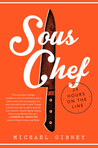
Snapshot Book Review: Sous Chef

Sous ChefSous Chef by Michael Gibney
My rating: 3 of 5 stars

It's important that I specify that I'm an outsider to the food industry. The closest I ever came to working in a restaurant was when I worked at a coffee shop on my college campus. While I suppose that technically "counts," it was also an insulated experience due to the fact that it was operated by the campus dining services and nearly impossible to get fired.

I enjoyed this book, but I think I'd have enjoyed it a lot more if I were part of the same insiders group as Gibney--that is, chefs, cooks, and anyone else involved in the preparation of food in a restaurant. You do get a sense of his experience in the kitchen, which is what I was looking for, but he sticks to the insider's lingo, which is alienating without footnotes to reference (I was halfway through the book before I discovered there was a glossary in the back!), and the frequent conversations the cooks have in Spanish are never translated, leaving me to guess what they might have said with the help of my incredibly limited knowledge of the language.

His descriptions of food in its various forms--packaged, raw, cut, cooked, served--are very beautiful and sensory, which is great, but for an impatient reader like me, I thought Gibney got carried away, so much so that he lost the forest for the trees. I didn't want to read a manual on how to properly de-bone a fish; I wanted a book that tells me a story. And this book, quite honestly, didn't. "A day in the life of" was a very accurate depiction, but at the end, I didn't much care about any of the characters, including Gibney himself. Sure they might be real people and this might be a real day, but I needed at least a whisper of a story in there, to keep me hooked. Instead, I was left feeling adrift as I turned the last page.

The book does earn three stars, however, because it accomplishes what it set out to do: give the reader the experience of being sous chef for a day. Complete with second-person narration and all. I read the book to understand that experience a bit better (admittedly as research for a book I intend to write), and I now feel that I do. So bravo for that. And now I'm going to go read a proper story.

View all my reviews

Monday, April 21, 2014

Snapshot Book Review: Save the Cat!

Save the Cat!: The Last Book on Screenwriting You'll Ever NeedSave the Cat!: The Last Book on Screenwriting You'll Ever Need by Blake Snyder
My rating: 5 of 5 stars

Loved this book! The only drawback is, well, I'm not a screenwriter. But I read this book at the behest of a friend who told me it would help me devise a strategy for working out plots, and it definitely fulfilled that promise.

My favorite aspect of this book was its tone: it reminded me of a coach giving tough-love instruction to his or her athlete. The message--over and over again--is, essentially, "You don't want to do this tedious, agonizing, impossibly hard bit of work? Well suck it up, because it's the only way to get the results that you want. So here's what you've got to do." Snyder's writing style is chatty yet informative. He offers personal experiences and notes from other writers and producers in the industry to exemplify why certain things work or don't work. Yes, at times he gets a tad repetitive, but in a how-to book, you pretty much have to be repetitive to ensure that your point sinks in. So I'll forgive that minor annoyance.

I'm excited to try some of the strategies. Now, if only someone would write this book, exactly the same, only different . . . for novel writers!

View all my reviews

Monday, April 14, 2014

Rutgers Recap

Let me cut to the chase: I didn't PR in the Rutgers Unite Half Marathon this past weekend. Which, of course, is disappointing.

Could I have run faster? Maybe. Should I have gone for broke at mile 10 and seen what happened? Probably. Can I come up with a thousand other excuses? Well let’s see, there was a lack of sleep the night before, a severely abbreviated warm-up before the race, and oh yeah, the fact that I raced another half marathon just seven days before…. But plenty of other runners have run under these—and worse—conditions and still PR-ed. Maybe I just wasn’t mentally prepared to run my best race; maybe I was ready to accept a lesser performance, because I had all of these excuses already in the back of my mind.

Regardless of why I ran a slower race, here’s what did go well:

The weather was perfect. (Sunny and warm enough to wear a singlet and shorts but cool enough to be comfortable at the start and finish lines.)

I had friends cheering me on.

I got to cheer on my friends (two of whom were running their first half marathon!).

I finished within the top 10 women running the race.

Best of all, I kicked it at the end and finished five seconds in front of a woman I had been trailing all race. It might sound evil, but there is no feeling like burning someone at the finish line. After all, that’s what makes it a race.

Rutgers Unite Half Marathon
Race Length
Finishing Time
Average Pace
Overall Place
Gender Place
Age Group Place
(F25-29)
13.1 mi
1:29:48
6:51/mile
66 / 3,131
6 / 1,604
2 / 285

Friday, April 11, 2014

Snapshot Book Review: Fahrenheit 451

Fahrenheit 451Fahrenheit 451 by Ray Bradbury
My rating: 3 of 5 stars

Five stars for concept. 3 stars for execution. 2 stars for pacing.

I will say up front that I can absolutely see why so many middle schools and high schools choose this book to include as part of their curriculum. As I was reading, I could imagine the types of essay questions that English teachers love to pose just springing out of the text: Choose a literature quotation from the novel and discuss the role it plays in developing the novel's themes. Discuss differences between dynamic and static characters in the book. Write about two of the following symbols: the Mechanical Hound, the salamander, fire, the subway, the sieve and the sand, the river.

However, I didn't read this book as part of my secondary education. I read it for pleasure. I read it because I was recently impressed by what I read from Bradbury, and this was one of those books of "classic literature" that was missing from my repertoire. And so many people love it!

Which brings me to a real problem: I hate when books (or movies, or anything really) are hyped before I read them, because I'm almost always disappointed. Farenheit 451, alas, was no exception. The concept was brilliant, and remains amazingly relevant in today's society. With our smartphones and video game consoles and computers and reality TV, our attention spans are shorter than ever. We want the condensed versions, and Reader's Digest won't do; say it in 140 characters or less, or no one will listen! We're all about headlines and captions, videos instead of articles, television instead of books. Poor books. They always seemed so threatened.

However, the main character's shift into rebellion happened too soon for me. I wanted to know more about how he became a firefighter, what his life was like before and why he was so contented with it before he met Clarisse. Why couldn't he just dismiss her as a silly little girl? Well, presumably because he was already on his way down the mental path of subversion, so what got him there? Unhappiness? Mildred was clearly unhappy, but she managed to wall herself in (pun intended) with distractions and diversions. What was so different about Montag?

Then, I assume that Montag's murdering Beatty was the climax, but then maybe that happened when the Mechanical Hound caught the other poor soul instead of Montag, so he knew he was finally "free." Or when the nuclear bomb went off? I just never felt the arc of the story quite vividly enough, so it prevented me from caring strongly what happened next. And for such a short book, there was so much rumination! I feel like so much that is there could be condensed, while so many details and scenes could have been added.

As a wise and reflective writer, Bradbury addresses some of these points in the Q&A that comes at the end of the 50th Anniversary Edition I read. And he's right: you shouldn't go back and change up the book when you're older and wiser. It needs to stay true to itself. So I'm not sorry I read it. I'm just sorry it wasn't quite the novel I thought it would be.

View all my reviews